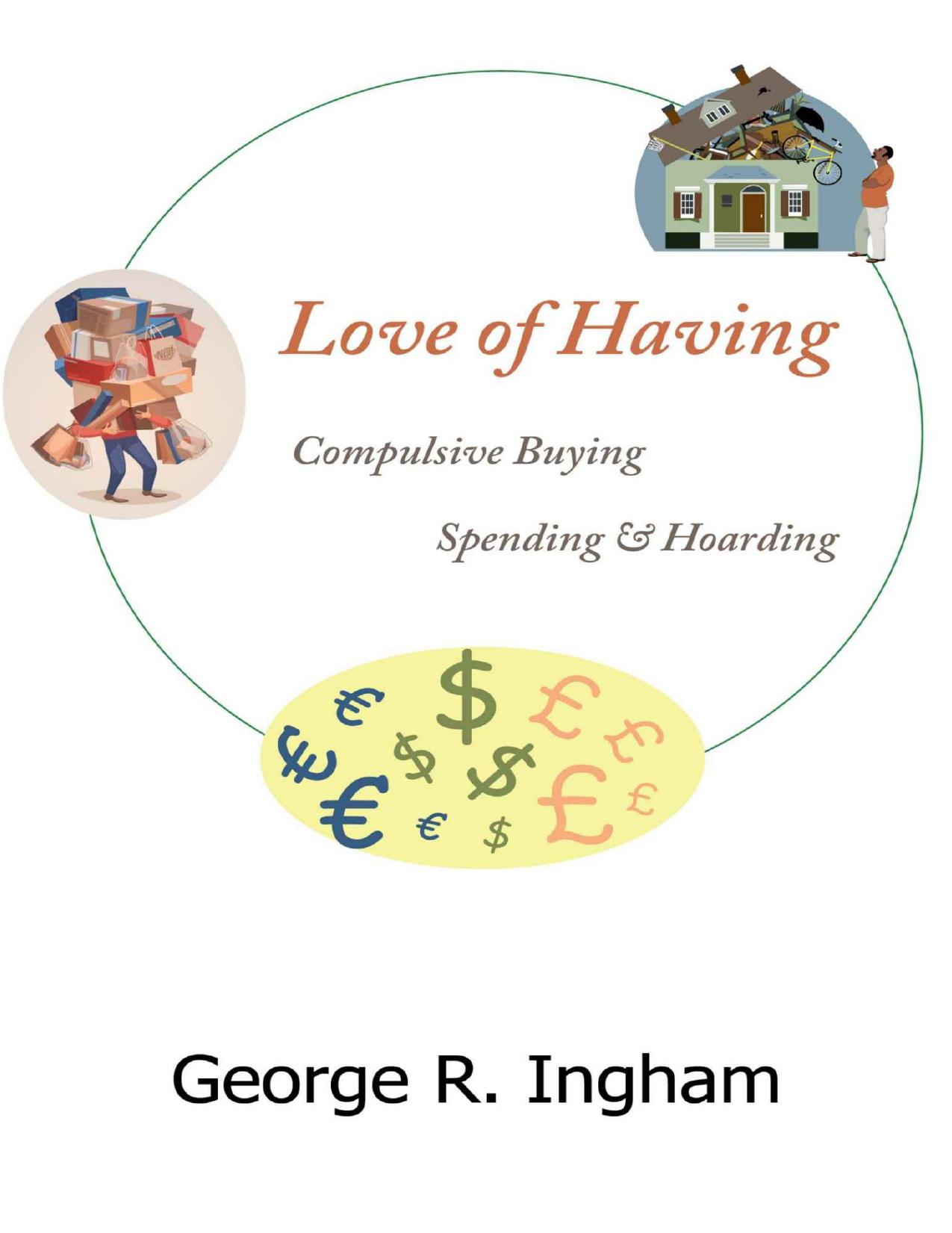
Love of Having: Compulsive Buying, Spending, and Hoarding by George R. Ingham
Author:George R. Ingham
Language: eng
Format: mobi, pdf
Publisher: George R. Ingham, Ph.D., LICSW
Published: 2015-12-15T03:00:00+00:00
Conclusion
The real measure of security is not what you have, but what you can do without.
Joseph Wood Krutch
You must bind me hard and fast, so that I cannot stir from the spot where you will stand me … and if I beg you to release me, you must tighten and add to my bonds.
Homer, The Odyssey
Whoever has the most stuff when he dies, wins.
Anonymous
Krishnamurti’s comment, at the beginning of this book, about conformity to a sick society is not health, should remind us that a positive outcome of psychotherapy may not simply be to get the client/patient to conform to society’s norms for good behavior. Nor should the therapist be in the business of choosing which social roles a particular client finds most fulfilling or life-affirming, whether it be grandmother, teacher, or entrepreneur. However, the therapist should help the individual determine which set of behaviors or dispositions contribute to achieving his or her goals, and which are leading to pain and suffering. Borrowing from Alasdair MacIntyre, we have seen that a central feature of therapy should be to help the client determine which set of behaviors are internal to the social roles she values, and which behaviors lead to external goods. It is interesting to note that this understanding of the goals of psychotherapy has significant features in common with the positive clinical psychology approach, such as the importance of building strengths of character, and the role of institutions and therapy in enabling or hindering these internal virtues.[521]
The question of personal freedom of action has been central (though not always center stage) in this book. In chapter 2, it was a question of possible external coercion ─ manufactured desire or, what was labeled the manipulationist thesis. In chapter 3, the issue of internal compulsion was seen to be Freud’s revolutionary contribution to a new (and much more complex) theory of action and desire. Unconscious intentional states (impulses, desires, cognitions, or motives) came into conflict with internalized norms in the form of the superego; and they are, therefore, repressed. But, nevertheless, they continue somehow to exert a repetitive, compulsive or pressing force on behavior. This force leads to anxiety and, ultimately, the construction of compromise intentional states which are symbolically associated with the original states.
Psychoanalysis was, therefore, from its very beginnings concerned with the existence of internal conflict and coercion; and the goal of therapy was to “replace compulsive and uncontrolled behavior by voluntary and deliberate conduct.”[522] Freud, like Hegel and Schopenhauer before him, was a proponent of the futility of desire. But, unlike his predecessors, Freud saw the instability and compulsive nature of desire as an innate and biological process of the organism.[523] Therefore, the external or social coercive forces play a subordinate role in his drama.
The principle contention of this book, however, is that both types of influencing forces, the internal as well as the external are required to reinforce each other in order to produce an ongoing disposition to perform compulsive behaviors such as compulsive buying, spending, and hoarding.
Download
Love of Having: Compulsive Buying, Spending, and Hoarding by George R. Ingham.pdf
This site does not store any files on its server. We only index and link to content provided by other sites. Please contact the content providers to delete copyright contents if any and email us, we'll remove relevant links or contents immediately.
Should I Stay or Should I Go? by Ramani Durvasula(7642)
Why We Sleep: Unlocking the Power of Sleep and Dreams by Matthew Walker(6688)
Fear by Osho(4724)
Flow by Mihaly Csikszentmihalyi(4675)
Rising Strong by Brene Brown(4440)
Why We Sleep by Matthew Walker(4423)
The Hacking of the American Mind by Robert H. Lustig(4359)
How to Change Your Mind by Michael Pollan(4343)
Too Much and Not the Mood by Durga Chew-Bose(4324)
Lost Connections by Johann Hari(4166)
He's Just Not That Into You by Greg Behrendt & Liz Tuccillo(3874)
Evolve Your Brain by Joe Dispenza(3655)
The Courage to Be Disliked by Ichiro Kishimi & Fumitake Koga(3475)
Crazy Is My Superpower by A.J. Mendez Brooks(3382)
In Cold Blood by Truman Capote(3367)
Resisting Happiness by Matthew Kelly(3332)
What If This Were Enough? by Heather Havrilesky(3300)
The Book of Human Emotions by Tiffany Watt Smith(3285)
Descartes' Error by Antonio Damasio(3264)
